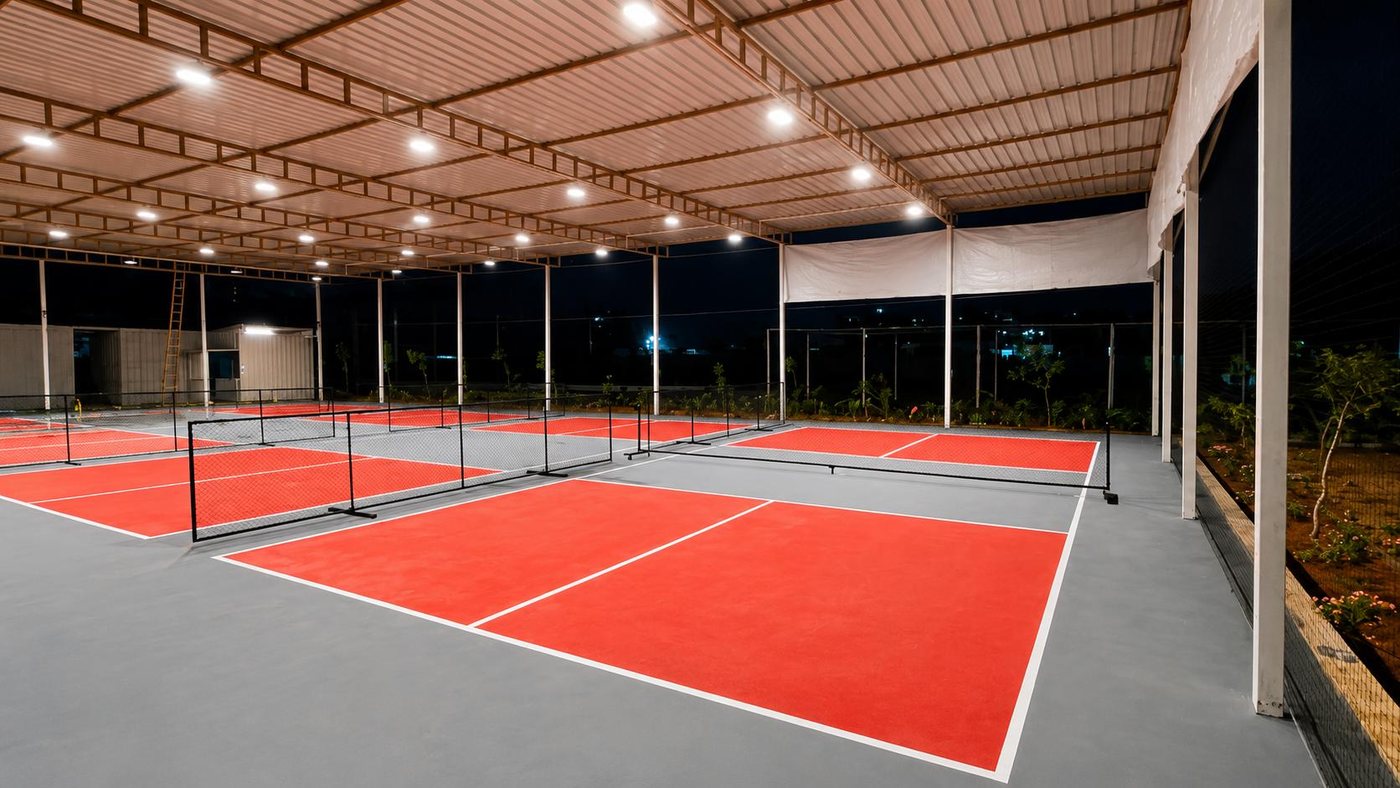
Pickleball, explained.
The fastest-growing sport in the world takes about ten minutes to learn. Here's everything you need before your first game — and a few things worth knowing for your hundredth.
What is pickleball?
Pickleball is a paddle sport played on a court about a third the size of a tennis court, with a solid paddle and a light plastic ball full of holes. Borrow the scoring from badminton, the court from a shrunken tennis court, and the soft touch from table tennis — that's roughly the game.
It has become the fastest-growing sport in the world for one simple reason: almost anyone can rally within minutes of picking up a paddle. The court is small, so you don't need to be fast. The ball is slow, so you don't need years of technique. The underhand serve is forgiving, so points actually start.
It also happens to be one of the few sports where a teenager, their parent and their grandparent can play the same game and all enjoy it. Play singles for a workout, doubles for the social side — most people play doubles, and most people arrive not knowing anyone.
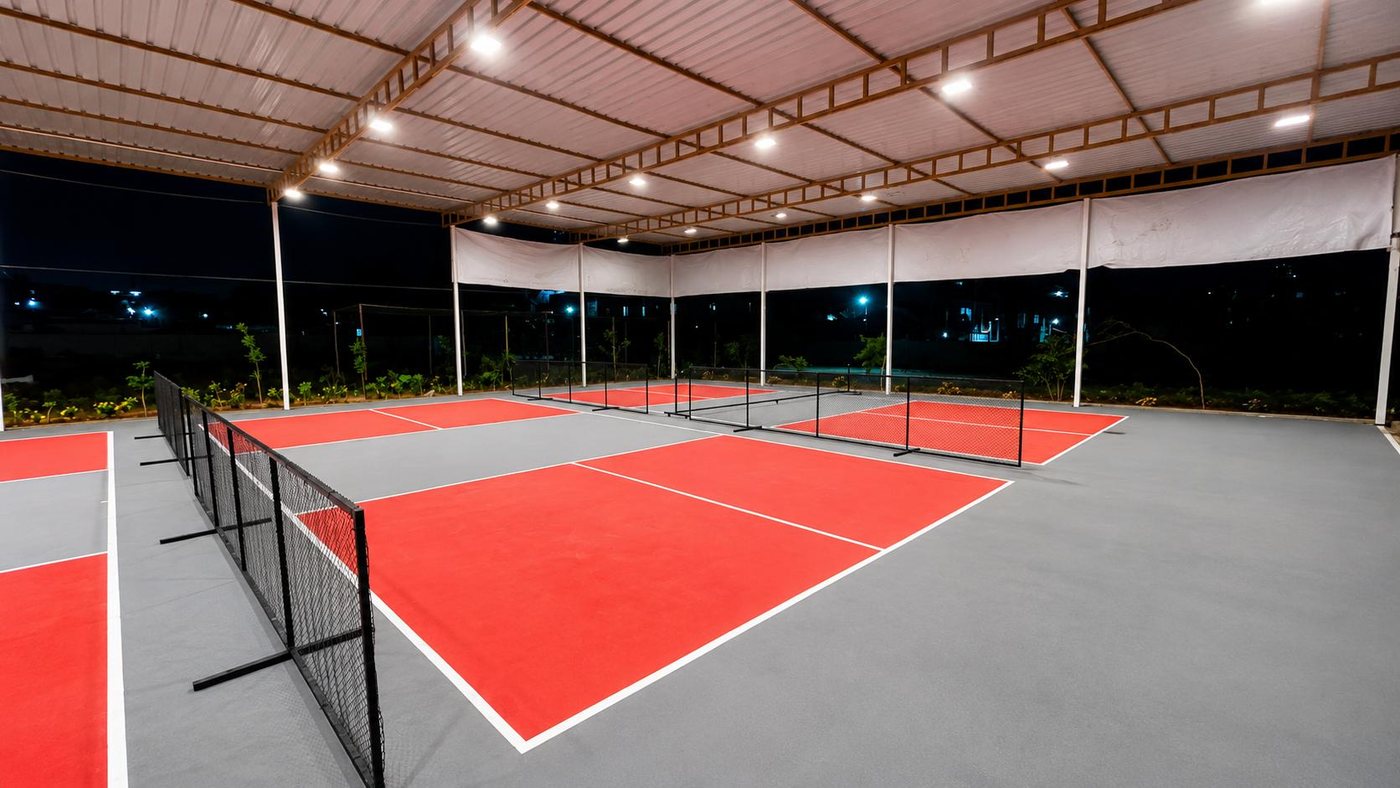
The whole game in one picture.
Learn the court first — almost every rule in pickleball is really a rule about where you're standing.
Paddle & ball
A solid paddle, larger than table tennis and smaller than tennis. The ball is light plastic with holes — it flies slower and lower than you'd expect, which is exactly what makes rallies last.
Singles or doubles
Doubles is the standard — two a side, four on court, and the format almost every social session uses. Singles is the same court and the same rules, played by two, and it is a far harder workout.
The serve
Underhand only, struck below your waist, with both feet behind the baseline. You serve diagonally to the opposite service court and it must clear the kitchen. One attempt — no second serve.
The two-bounce rule
The single rule beginners forget. The serve must bounce before the returner hits it, and the return must bounce before the serving team hits it. Only after those two bounces can anyone volley.
The kitchen
The 7 ft zone either side of the net. You may stand in it any time — you simply cannot hit the ball out of the air while you're in there, or while your momentum is carrying you in.
Scoring points
Only the serving side can score. Win the rally on your serve and you take a point; lose it and the serve passes on. This is why games swing — you have to earn the serve before you can earn a point.
Winning a game
First to 11 points, but you must win by two — so 11–9 wins and 11–10 doesn't. Matches are usually best of three. Social sessions often just play to 11 and rotate the court.
How long a game takes
A game to 11 usually runs 15–20 minutes, so an hour on court comfortably fits three or four games with breaks. Book two hours if you're a group of six or more and want everyone playing.
Standard pickleball rules.
You don't need all of this to start playing. Open whichever section you need, when you need it.
Serving rules
- The serve is struck underhand, with contact below the level of your waist.
- The paddle head must be below your wrist at the moment of contact.
- Both feet must be behind the baseline, inside the imaginary extensions of the centre line and sideline.
- You serve diagonally, into the service court opposite you.
- The serve must clear the net and the kitchen entirely. A serve landing on the kitchen line is out.
- You get one attempt. There is no second serve.
- A "drop serve" is also legal — drop the ball, let it bounce, then hit it.
Serve rotation and who serves next
In doubles, both partners get a turn to serve before the serve passes to the opponents — with one exception that catches everyone out.
- The very first service turn of the game goes to one player only. That's why the game starts at 0–0–2: the starting server counts as "second server", so if they lose the rally, the serve goes straight across.
- After that, when your side wins the serve, your right-hand player serves first.
- You serve from the right when your team's score is even, and from the left when it's odd.
- Partners swap sides with each other every time your side scores — the opponents never move.
Scoring system and calling the score
Only the serving side can score a point. Games go to 11, win by two.
- Doubles — call three numbers before every serve: your score, their score, then 1 or 2 for whether you're the first or second server. "Six–four–two."
- Singles — call two numbers: your score, then theirs.
- Calling the score out loud isn't just etiquette — it prevents most disputes before they happen.
Faults — every way to lose a rally
- Hitting the ball into the net, or out of bounds.
- Volleying the ball while standing in the kitchen, or touching the kitchen line.
- Volleying before both the serve and the return have bounced.
- Failing to let the ball bounce when you were required to.
- A serve that lands in the wrong service court, in the kitchen, or on the kitchen line.
- The ball touching you or anything you're wearing or carrying, other than your paddle.
- Touching the net, net post or your opponent's side of the court while the ball is live.
- The ball bouncing twice before you return it.
Kitchen (non-volley zone) rules
The kitchen is the 7 ft zone on each side of the net, and it exists to stop the game becoming a smash-fest at the net.
- You may stand in the kitchen whenever you like.
- You may not volley — hit the ball out of the air — while any part of you is touching the kitchen or its line.
- If your momentum carries you into the kitchen after a volley, that's still a fault, even if the ball is already dead.
- You may step into the kitchen to play a ball that has bounced. That's the dink, and it's the heart of the game.
- Before you volley again, you must re-establish both feet outside the kitchen.
Lines and out-of-bounds
- A ball touching any line is in — with one exception.
- The exception: a serve landing on the kitchen line is out.
- Call the ball out only if you're sure. If you and your partner disagree, or you're genuinely unsure, the ball is in.
- Only the team on the side where the ball lands makes the call.
Lets and replays
- Since the rule change, a serve that clips the net and still lands in the correct service court is live — play on. There is no let serve.
- Genuine replays are for outside interference: a ball rolling in from the next court, someone walking behind the baseline, anything unsafe.
- Either side can call a replay for safety. Nobody should feel awkward doing so.
Singles rules — what changes
- Everything on the court stays the same size. Yes, all of it.
- You serve from the right when your score is even, from the left when it's odd.
- Your opponent receives diagonally opposite, positioned by your score.
- Lose the rally and the serve simply passes over. There's no first or second server.
- The two-bounce rule and every kitchen rule apply exactly as in doubles.
Doubles rules — what changes
- Both partners serve before the serve passes over — except in the very first service turn of the game.
- Either partner may play any ball, wherever it lands. There are no fixed sides during a rally.
- Only the serving team swaps sides, and only after scoring a point.
- The receiving team never swaps positions during a service turn.
Standard game and match format
- Games are played to 11 points, win by two.
- A match is normally the best of three games.
- Tournaments sometimes use 15 or 21 points, still win by two — this is announced beforehand.
- Teams switch ends at the halfway point of the deciding game, so nobody has the light or the breeze all match.
- Social sessions at the club usually play a single game to 11 and rotate, so more people get on court.
Court etiquette.
None of this is policed. It's just how good courts stay good — and it's most of what makes a club feel like a club.
- Turn up a few minutes early. Shoes on and warmed up when your hour starts means you actually get your hour.
- Finish on time. Someone is waiting courtside. Play the last point, shake hands, clear the court.
- Wait for the rally to end before walking behind or across a court. Ten seconds of patience prevents most collisions.
- Return stray balls safely. Wait until the neighbouring rally finishes, then roll it back along the ground — never hit it across.
- Play down to the beginner, not at them. Everyone on this court was hopeless once. Feed them a rally they can return.
- Keep the volume friendly. Cheering is welcome. Music, speakerphone calls and coaching from the sidelines usually aren't.
- Nothing aggressive, ever. Abusive language, threats or intimidation end your session on the spot.
- Leave it as you found it. Bottles, tape, wrappers and stray balls go with you when you walk off.
Equipment guide.
Less than you'd think. For your first few sessions, court shoes and water are genuinely the only things that matter.
The paddle
Starters want a mid-weight paddle, roughly 210–230 g — light enough to react at the net, heavy enough to carry the ball. Don't spend big until you know whether you like power or control.
The ball
A hollow plastic ball with 26–40 holes. Outdoor balls are harder with smaller holes; indoor balls are softer. Covered courts like ours generally play best with an outdoor ball.
Court shoes — the one that matters
Wear proper non-marking court shoes. Running shoes are built to roll forward and offer nothing sideways; pickleball is almost entirely sideways. This is where beginners get hurt.
What to wear
Breathable sportswear you can move in, and something to wipe your hands. Bengaluru evenings are kind, but you will still sweat more than you expect in the first month.
Bring with you
Water, a small towel, and a change of shirt if you're heading to the café after. Everything else is optional for your first few visits.
What the club provides
Court hire includes the net and the playing surface, floodlights and courtside seating. Paddle and ball provision: [INSERT LAKESIDE PICKLE CLUB POLICY]
Rental & loan
Paddle rental, ball supply and rates: [INSERT LAKESIDE PICKLE CLUB POLICY] Tell us in the booking notes if you'd like paddles held for you and we'll confirm on WhatsApp.
Changing & storage
Changing rooms, lockers and shower facilities: [INSERT LAKESIDE PICKLE CLUB POLICY]
Player skill levels.
Be honest rather than modest — it makes for better games on both sides of the net. Nobody minds a beginner who says so.
You're learning where to stand, how to keep a serve in, and what the kitchen is for. Rallies are short and that's completely normal.
- New to racquet sports, or new to this one
- Still thinking about the two-bounce rule
- Wants rallies, not winners
You serve consistently, sustain rallies, and you're starting to dink rather than smash everything. You know why you lost the point.
- Reliable serve and return
- Moves to the kitchen line deliberately
- Beginning to place shots, not just return them
You control pace deliberately, work the third-shot drop, and play as a pair rather than two individuals. Points are won by patience.
- Consistent third-shot drop and reset
- Strong court coverage with a partner
- Comfortable in extended kitchen exchanges
Booking & court usage.
Courts are open 6 am to 10 pm, seven days a week, at ₹600 per court-hour — the same rate every day, with no peak or weekend surcharge.
- Book on the court board. Pick your date, court and hours on the Pickle Club booking board — it opens a WhatsApp message and we confirm from there.
- One hour per booking, and you can select several hours back to back for a longer session.
- Up to four players per court are included in the hour.
- More than four? Book two courts and rotate — it's the format most groups prefer anyway.
- Advance booking window — [INSERT LAKESIDE PICKLE CLUB POLICY]
- Cancellation & rescheduling — [INSERT LAKESIDE PICKLE CLUB POLICY]
- Late arrival — [INSERT LAKESIDE PICKLE CLUB POLICY]
- No-show — [INSERT LAKESIDE PICKLE CLUB POLICY]
- Extending your session — [INSERT LAKESIDE PICKLE CLUB POLICY]
Safety guidelines.
Pickleball is gentle on the body compared to most racquet sports — right up until someone sprints for a drop shot in running shoes.
- Warm up first. Five minutes of gentle movement and some shoulder and ankle rotations. Most pickleball injuries are cold-start injuries.
- Court shoes, always. The lateral movement is what does the damage, and running shoes give you nothing sideways.
- Drink more than you think. Covered courts feel cooler than they are. Bring water and actually use it between games.
- Never back-pedal for a lob. Turn and run instead. Backwards falls cause the worst injuries in this sport.
- Paddles are not for swinging around. Keep them under control between points, especially with children on court.
- Don't cross an active court. Wait for the rally to end, then walk behind the baseline.
- Report anything unsafe — a damaged net, a slippery patch, a light that's out. Tell any staff member and we'll take the court out of play.
- First aid and emergencies — [INSERT LAKESIDE PICKLE CLUB PROCEDURE]
Never played before?
Then you're exactly who this court was built for. Here's the whole thing, start to finish.
Book a court
Pick an hour on the booking board. Bring three friends, or come as two and play singles.
Grab a paddle
Borrow one rather than buying. You'll know what you want after a few sessions.
Learn the basics
Serve underhand, let it bounce twice, stay out of the kitchen when volleying. That's genuinely enough.
Get on court
Rally before you keep score. Ten minutes of hitting beats an hour of reading.
Have fun
Then walk fifty metres to the café and argue about that line call over coffee.
₹600 per court-hour · up to 4 players · 6 am–10 pm, every day
Pickleball glossary.
Twelve words that will get you through your first month courtside.
- Serve
- The underhand shot that starts every rally, hit diagonally from behind the baseline. One attempt only.
- Rally
- Everything between the serve and the point ending. Good pickleball is long rallies, not quick winners.
- Fault
- Any action that ends the rally against you — into the net, out of bounds, or a kitchen violation.
- Volley
- Hitting the ball out of the air before it bounces. Legal anywhere except from inside the kitchen.
- Dink
- A soft shot dropped just over the net into the opponent's kitchen. The most important shot in the game.
- Drive
- A hard, flat, low shot hit with pace — usually from the baseline, usually to force an error.
- Lob
- A high, deep shot over your opponents' heads, sending them scrambling back from the kitchen line.
- Smash
- The overhead put-away, hit down hard on a ball that's floated too high. Also called the overhead.
- Kitchen
- The 7 ft non-volley zone either side of the net. Stand in it freely — just don't volley from it.
- Let
- A rally replayed for outside interference. Note that a serve clipping the net is no longer a let.
- Two-bounce rule
- The serve must bounce, and the return must bounce, before anyone is allowed to volley.
- Side-out
- When the serve passes to the opposing team. In doubles, only after both partners have served.
Frequently asked.
Do I need to bring my own paddle?
Not to get started — most people borrow for their first few sessions and buy once they know what they like. Paddle availability and rental at the club: [INSERT POLICY]
Can complete beginners play?
Yes, and more of our players started this year than you'd guess. Pickleball is unusual in that a genuine beginner can hold a rally within about ten minutes. Read the how to play section, book an hour, and rally before you bother keeping score.
Can I book as a single player?
You can book a court on your own — the booking board doesn't require four names. If you'd rather be matched into a game, open play sessions and social groups are the usual route. Solo-player matching and open play scheduling: [INSERT POLICY]
How many people can play on one court?
Four — doubles, two a side — and that's included in the ₹600 court-hour. Two play singles. Larger groups usually book two courts and rotate so nobody sits out for long.
Do you provide balls?
[INSERT POLICY] Mention it in your booking notes and we'll confirm on WhatsApp before you travel.
Can children play?
Pickleball is one of the easiest sports for children to pick up, and one of the few they can genuinely play alongside adults. Minimum age, supervision requirements and junior sessions: [INSERT POLICY]
What should I wear?
Breathable sportswear and — the part that actually matters — non-marking court shoes. Running shoes are built for forward motion and pickleball is almost entirely lateral, which is how most beginner injuries happen. Bring water.
Can I cancel or move my booking?
Cancellation, rescheduling and refund terms: [INSERT POLICY] Until that's published, message us on WhatsApp as early as you can and we'll do our best to move you.
Do you offer coaching?
Coaching programmes for beginners and improving players run at the club. Session formats, coach availability and pricing: [INSERT POLICY] Message us on WhatsApp and we'll set it up.
Can I join an open game?
Open play sessions and community leagues are part of how the club is meant to work — turn up alone, leave with a regular foursome. Schedule, format and how to join: [INSERT POLICY]
Venue terms & conditions.
The structure is set out below. Marked clauses are awaiting confirmation and are not yet in force.
Booking confirmation
A booking request submitted through the court board is a request, not a confirmed reservation. Your court is confirmed only once Lakeside Pickle Club responds to confirm it. Confirmation timelines and any deposit requirement: [INSERT LAKESIDE PICKLE CLUB POLICY]
Cancellation & refunds
Notice periods, refund eligibility and credit arrangements: [INSERT LAKESIDE PICKLE CLUB POLICY]
No-show
Treatment of confirmed bookings where players do not arrive: [INSERT LAKESIDE PICKLE CLUB POLICY]
Late arrival
Court time runs from the booked start time. Whether late arrivals may extend into the following hour depends on availability. Grace periods: [INSERT LAKESIDE PICKLE CLUB POLICY]
Court usage
- Courts are for pickleball only, during the hours booked.
- Non-marking court shoes are required on the playing surface.
- Coaching for commercial gain by external coaches requires prior written permission from the club.
- Food and drink on the playing surface: [INSERT LAKESIDE PICKLE CLUB POLICY]
Damage to venue or equipment
Players are responsible for damage caused by wilful misuse or negligence. Assessment and recovery of costs: [INSERT LAKESIDE PICKLE CLUB POLICY]
Personal belongings & lost property
Personal belongings are brought onto the premises at the owner's risk. Lost and found retention period and collection process: [INSERT LAKESIDE PICKLE CLUB POLICY]
Photography & video
Personal photography is generally welcome. Commercial shoots, drones and club use of images for marketing: [INSERT LAKESIDE PICKLE CLUB POLICY]
Children & minors
Minimum age for court bookings, adult supervision requirements and guardian consent: [INSERT LAKESIDE PICKLE CLUB POLICY]
Smoking & alcohol
Rules on smoking and on alcohol on or adjacent to the courts: [INSERT LAKESIDE PICKLE CLUB POLICY]
Right of admission
Lakeside Pickle Club reserves the right of admission. Abusive, threatening or unsafe conduct will end a session immediately and without refund.
Weather & force majeure
Courts are covered and play continues in most weather. Where conditions, power failure or events beyond the club's control make play unsafe, alternative arrangements: [INSERT LAKESIDE PICKLE CLUB POLICY]
Liability & personal injury
Pickleball carries an inherent risk of injury. Players participate at their own risk and should satisfy themselves that they are medically fit to play. The precise limitation of liability, insurance position and any waiver requirement: [INSERT LAKESIDE PICKLE CLUB POLICY — LEGAL REVIEW REQUIRED]
Questions about any of the above? Message us on WhatsApp.